How many strings does a viola d’amore actually have, and why do we sound different? Here, our musicians introduce their instruments.
Violin
You almost always need it, it plays almost all the time (which is why violinists are notoriously bad at counting rests), and they appear in packs - which doesn’t exactly make social interaction among them easier: the violin is the alpha animal of the orchestra…
One of the many - but by far the most striking - differences from modern instruments is the gut strings of Baroque violins. Finding a type of string that suits both the instrument and the player is a lengthy and patience‑testing process. Gut strings react very sensitively to climatic conditions. High humidity can cause the strings and their response to deteriorate to the point of near unplayability. The risk of breakage - especially of the E string -is ever present, and the ability to change a snapped string extremely quickly during a concert is a considerable advantage.
The technical demands of Baroque music on the violinist differ radically from those of Romantic music. The left hand is less challenged, while the right hand - the bow arm - carries far more responsibility. Among the string family, the violin is the lightest instrument in terms of weight, which is not an insignificant detail given the amount of travel involved.
Viola
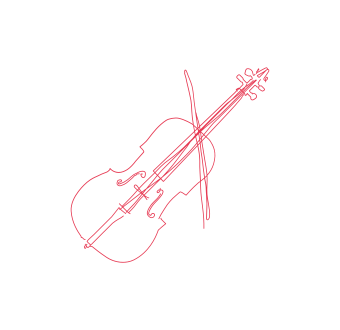
The viola holds the musical threads together, comparable to the flavor of a dish. Brilliance is not its nature - unless a composer specifically seeks this dark color, as in its showpiece, Johann Sebastian Bach’s Sixth Brandenburg Concerto…
The historical instruments are the starting point for the sound. They are, so to speak, our language - the means through which we express ourselves. They often require a completely different approach from their modern counterparts. Gut strings have much more ‘grip,’ more resistance; they demand shaping of each individual tone. And at the same time, they are much warmer, resonate more strongly - in contrast to a synthetic string, which often practically calls for vibrato in order to make the sound come alive.
For us string players, however, the choice of bow is absolutely central. Since we have no recordings from long‑past times, it is above all the bows - of which quite a number of original models still exist - that tell us so much about the sound ideal of each period. I am always fascinated to try a new bow and discover what it has to ‘tell’ me from back then. A collection could never be complete; there are countless different models, and in every corner of Europe people were experimenting with different ideas, so that one could in principle play a different bow for every region and every period!
An early Baroque bow has hardly any strength at the tip, so the sound naturally tapers off. Up‑bow and down‑bow sound very different - a series of identical tones simply does not exist. Bows changed the most over time: already in the Classical era they are significantly longer and more balanced in weight, yet compared to today still very light, very springy, and extremely responsive. In the 19th century, development moved toward models with a very heavy tip: once they lie on the string, it is almost impossible to lift them again. Articulation was no longer done at the frog, but now at the top. The ideal of a legato sound shaped the era. I can well imagine the excitement of the time - that one could now produce tones that no longer automatically diminished in volume. It was celebrated, and an entirely new playing technique developed, with a stiff upper arm and an opening elbow.
By contrast, violins and violas have changed only minimally. Apart from string choice - and the real departure from gut strings only took hold after the Second World War - it is above all the ‘inner values’ that changed. The instruments became louder and more focused, and thus were given a stronger bass bar - though at the expense of a rounder, more purring sound. Fascinating to me is also the shift in string tension: in the Baroque era, one assumed equal tension across all strings, from low to high, but this gradually shifted in favor of the higher strings, which were meant to become increasingly penetrating. Melody became the guiding principle of construction. Baroque music, by contrast, was always shaped from below; bass and harmony determined its course.
The viola sits exactly between these worlds - built like an oversized violin, but while the smaller sibling quickly found its ‘ideal’ proportions, there has never been a standard size for violas. At Akamus we therefore often divide multi‑part viola lines according to the sizes of the instruments available! We are an extremely adaptable instrument: sometimes reinforcing the bass in a higher register (4‑foot), sometimes acting as a third melodic voice below the two violins, often shaping the harmony, and sometimes simply providing filling.
Viola d’amore
Playing the viola d’amore presents a whole range of challenges. They begin with the tuning of the instrument, which is always different and usually depends on the key of the piece being performed. All 14 strings must be in tune - 7 played strings and 7 sympathetic strings - which is a major task, especially in cold churches…
This becomes particularly daunting when Bach’s St John Passion is on the program, in which the use of two violas d’amore is among the work’s sonic highlights.
Since we play viola or violin earlier in this work, the close spacing of the viola d’amore’s playing strings poses an additional challenge. When switching from viola to viola d’amore in concert, one must be thoroughly accustomed to the instrument and extremely precise with the bow’s angle, otherwise several strings may sound at once -an effect that does not always fit the harmony. And then we must trust that the strings we tuned before the performance will actually hold. This is very nerve‑racking and often causes considerable frustration for us performers. The upper seven bowed strings are usually four plain gut strings and three wound strings made of silver or copper, each reacting very differently to warmth, humidity, or cold. Then there are the seven sympathetic strings, the so‑called aliquot strings. These are not bowed; they run through the bridge and underneath the fingerboard, and can only be plucked with the finger for tuning. They provide the viola d’amore’s beautiful resonance. To prepare the instrument perfectly, we really need absolute quiet - something that is rarely available. For this reason, viola d’amore players spend a great deal of time tuning and are delighted when everything holds. A true disaster occurs when an aliquot string breaks just before the concert. It must be threaded through a plastic tube (or even a drinking straw) under the fingerboard all the way up to the scroll - a tricky procedure even for violin makers who specialize in this instrument. But despite all its challenges, this wonderfully resonant instrument offers immense joy -both in playing and in listening

Double Bass & Violone
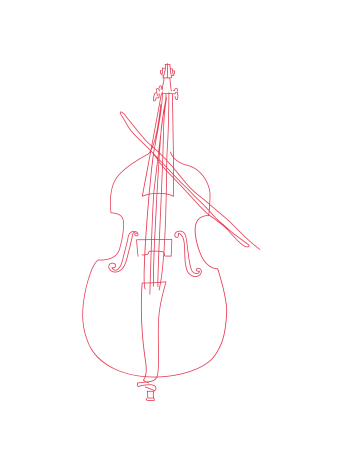
Anyone who engages more deeply with the historical double bass or the violone needs one thing above all: space – ideally a large room for many instruments and a wide variety of bows. In the end, it resembles a collection of cars: you begin with one vehicle – and later wonder where all the others came from…
Once the right double bass has been found, the next steps go far beyond choosing the correct setup; they often involve meticulous rehearsal work aimed at approaching a historically developed understanding of sound.
In the Baroque and Classical periods, the term double bass referred to a wide range of bass instruments whose construction, tuning, and function were shaped by their musical context. Depending on whether an instrument provides the sonic foundation in a very low register or is used closer to the violoncello in a higher register, not only its role within the ensemble changes, but also the way musical lines are conceived and formed.
This diversity is inseparable from historical scordature, that is, different string tunings. The so‑called Viennese tuning (Wiener Stimmung), which was widespread in Central Europe in the 18th century, opens up specific fingerings, resonances, and articulation possibilities through its special string arrangement; other scordature influence sound and playing technique in similar ways. Likewise, the shape and origin of the instrument - such as Italian bass designs with their more immediate response - along with features like gut frets and the choice of bow, whether a hammer‑head bow or an Italian or French Baroque bow, all interact directly with one another.
Out of this interplay arises what we call historically informed performance.
Basset clarinet
At the end of the 1780s, the Viennese court clarinettist Anton Paul Stadler developed a new enigmatic clarinet together with the imperial-royal court instrument maker Theodor Lotz. What is special about the basset clarinet?
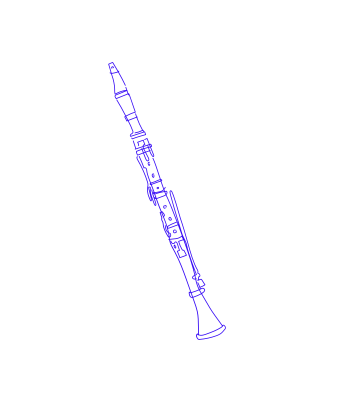
The basset clarinet had an expanded tonal range, and they called it an Inventionsklarinette (invention clarinet). Since no examples of it have survived, for a long time there was insufficient information to know the exact shape of the instrument that is now known as the basset clarinet. It was only in the 1990s, when program notes from Stadler’s performances in Riga from 1794 with roughly engraved images were found, that the secret of the actual appearance and functionality of this instrument was discovered…

Its range is five semitones lower than that of a conventional clarinet and makes it possible to compose for a range of more than four octaves. The additional tones are produced by special long-style keys that are operated with the thumb of the right hand. In order to play even lower, an unusual amount of physical effort is required: if - in addition to these keys - the player closes the lowest tone hole with his leg or knee, the instrument’s lowest note B is reached. Thanks to its striking bell, which is reminiscent of a hollowed-out ball, the basset clarinet also has a suggestive and intimate sound.
At the time, playing quietly was considered a specialty of Stadler, about whom people wrote with admiration that “one almost believes he doesn’t blow.” Not only Stadler’s clarinet, for which he supposedly never paid the instrument maker Lotz, but also the original sheet music of the clarinet concerto was unfortunately lost. Around 1801, three publishers published prints of the clarinet concerto, but in versions for the much more popular clarinet in A, therefore missing the particularly attractive low tones of the basset clarinet. As a result, the clarinet part was significantly cut, a practice that remains often common in performances to this day.
On our recording, however, a clarinet part is used, which is designed taking allknown sources into account and includes the basset tones. The instrument used was reconstructed from boxwood by the Innsbruck master instrument maker Prof. Rudolf Tutz. The illustrations on the program notes from Riga served as a model, although the number and mechanics of the keys are not clearly shown.
With a historical basset clarinet, the forked handles, i.e. handles in which holes remain open between the resting fingers, produce a particularly wide range of different timbres. Only then do numerous tongue-in-cheek details within Mozart’s composition become apparent, which could have arisen from his humorous friendship with Anton Stadler. For example, certain sequences of notes in the first movement are almost unplayable and have a ghostly sound due to the demanding fingering technique. Mozart knew the clarinet very well, and in his composition instructions, he advised his student Thomas Attwood to only write for the clarinet in C and F Major. This indicates that he deliberately challenged his friend Stadler in terms of playing technique.
(translation: Calvin B. Cooper)
Trumpet
Historical trumpets sound warmer and softer; they blend much better with other instruments and even with the human voice. Even without valves, the natural trumpet lacks nothing. On the contrary, it offers a richer spectrum of overtones…
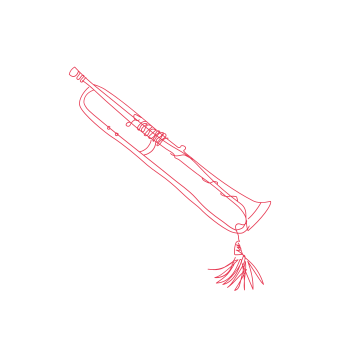
The Baroque trumpet (or natural trumpet) differs from modern trumpets in that it has no valves. Its basic principle is simply a long tube. At one end is a mouthpiece, which transmits the sound we players produce, while the tubing itself acts as an amplifier. At the other end is a bell (or flare), whose size and shape determine how loud or soft the sound will be. The fundamental pitch depends on the length of the tube. Most trumpet parts in the Baroque period were written for trumpets in D or C. Since C major is lower than D major, a C trumpet is longer in this case - because the longer the tube, the lower the pitch.
As a trumpeter, I can therefore only play in one key and cannot follow harmonic changes freely, since the Baroque trumpet offers only a fixed natural harmonic series. This natural series is a physical law that determines which notes are playable. If a Classical symphony modulates between keys, we must use so-called crooks: by attaching a different crook, a D trumpet can, for example, become a C trumpet. This allows the same natural harmonic series to begin on a different fundamental and thus fit a new key. A similar principle exists for valveless horns -although horn players can also use their hand in the bell to adjust pitches, something that is not possible on the trumpet.
Today, the modern valve trumpet is usually pitched in B-flat or C. Another major difference between “old” and “new” instruments is that the tubing of the Baroque trumpet is about twice as long as that of the modern instrument. This produces more overtones, which resonate and shape the sound. And that is exactly why I love playing historical instruments. I can play forte, achieving brilliance and brightness without overpowering everything else. At the same time, I can blend on equal terms with a violin, oboe, or voice -without anyone saying, “The trumpet is too loud!”
Every pitch is altered solely through changes in lip tension and tongue position. I have no valves to rely on for security when changing notes. One must have a well-trained ear, a clear concept of pitch, and plenty of practice - otherwise it is very easy for a note to “crack.” This makes the instrument quite demanding to play. In addition, much of the playable repertoire lies in the high register, meaning that strong, well-trained upper notes are essential.
Yet all the challenges of a natural instrument are outweighed by its warm, colorful sound, which I deeply prefer. I also personally love the music of the Baroque and Classical periods. For me, it is clear that this music must be performed on the instruments of its own time. The valve was only invented around 1815. Playing Bach’s B minor Mass on a valve trumpet is, to me, unthinkable -the sound then becomes too bright and too sharp.